logo
  • ABOUT BILARABY
    • About Us logo
    • Press Releases logo
    • Blogs logo
    • Terms and Conditions logo
    • Privacy Policy logo
    • Contact Us logo
  • EVENTS AND PROGRAMS
    • BilAraby Annual Gatheringlogo

      BilAraby Annual Gathering, the annual event hosted in Doha, Qatar

    • BilAraby Eventslogo
  • CONTENT HUB
    • Videoslogo

      Listen to our inspirational speakers who drive change with their powerful ideas and experiences.

    • BilAraby Talkslogo

      The Annual Gathering, held in Doha each April, is the stage on which 16 speakers present their inspirational ideas

    • Podcastlogo

      Listen to our inspirational speakers who drive change with their powerful ideas and experiences.

  • PARTICIPATE
    • Nominatelogo

      Got an idea that will really inspire people, or a story that’s so amazing you just have to share it with the world?

    • Became a Partnerlogo

      Join us in shaping the future of Arabic creativity.

  • TRANSLATE
  • SIGN IN/SIGN UP
  • ABOUT BILARABY
    • About us logo
    • Press Releases logo
    • Blogs logo
    • Terms and Conditions logo
    • Privacy Policy logo
    • Contact Us logo
  • EVENTS & PROGRAM
    • BilAraby Annual Gatheringlogo

      BilAraby Annual Gathering, the annual event hosted in Doha, Qatar

    • BilAraby Eventslogo
  • CONTENT HUB
    • Videoslogo

      Listen to our inspirational speakers who drive change with their powerful ideas and experiences.

    • BilAraby Talkslogo

      The Annual Gathering, held in Doha each April, is the stage on which 16 speakers present their inspirational ideas

    • Podcastlogo

      Listen to our inspirational speakers who drive change with their powerful ideas and experiences.

  • PARTICIPATE
    • Nominatelogo

      Got an idea that’ll really inspire people, or a story that’s just so amazing you’ve got to tell the world?

    • Became a Partnerlogo

      Join us in shaping the future of Arabic creativity.

  • TRANSLATE
  • Accessibility
  • Font Size
  • Contrast
logo logo

Sign Up toBilAraby

Already have an account? Sign In
dropdown icon
dropdown icon
logo
logo
By signing up, I agree to the Terms & Conditions and Privacy Policy.
Sign Up
logo

Add Profile Picture

User Icon
Continue Skip for now
Please upload a profile picture before continuing.

Topics
logo
Education
logo
Science & Technology
logo
Culture
logo
Innovation
logo
Community
logo
Music

Please select at least one topic before continuing.
Continue Skip for now

Choose your Preference
Please select at least one preference before continuing.

Done
logo logo

Welcome Back

Don't have an account? Sign up
logo

Forgot Password?
logo logo

Forgot your password

Enter your email address to reset
Send Back to Sign in
logo

Reset your Password

Please fill the below fields
logo
logo
Go to home page
  1. Home
  2. Press Releases
  3. Amplifying Arabic: Youth, Identity, and Innovation at QF’s BilAraby Summit

Amplifying Arabic: Youth, Identity, and Innovation at QF’s BilAraby Summit

logo
0
logo
3 min
logo
20 April 2025
logo
BilAraby
banner

The discovery sessions on the second day of the summit explored ways to enhance the representation of the Arabic language in the digital landscape

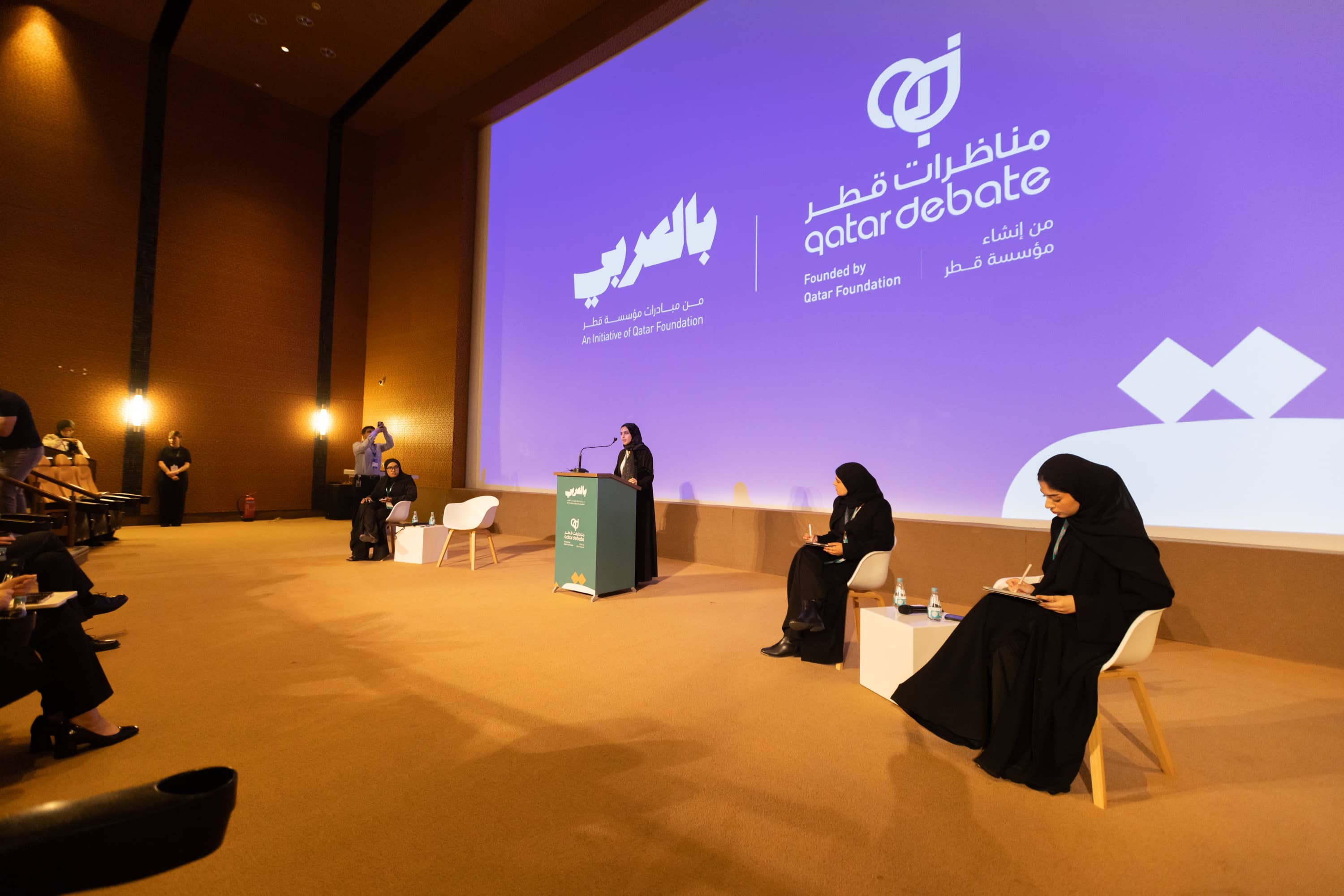
The second and final day of Qatar Foundation’s BilAraby Summit featured a number of talks that discussed the Arabic language’s representation in the digital spaces, including the emergence of new methods for using the language on social media, and the influx of foreign words. These sessions were held by a number of Qatar Foundation (QF) entities, including QatarDebate, Qatar Foundation International (QFI), and the BilAraby Summit. 

The session by QatarDebate sparked a conversation by posing the question – Has social media negatively impacted the use of Arabic in communication and correspondence? Or is it merely an influencing factor like other factors? 

Participants had differing views on the issue, noting new uses of Arabic and changing how it's used on digital platforms.

Safia Al-Hamad, a student at Qatar University, expressed her concern about the profound impact of social media on the Arabic language. She said: “Because of social media, we have been exposed to words that have no Arabic equivalent and we’ve adopted them.”She added: “Social media has become our means of communication, even in our daily lives. Those who do not master this language seem isolated from the world.”

Her fellow student, Sarah Al-Naama, echoed this view stating, “Even if it seems like the choice is ours, programming and prevailing trends have guided our interactions from the beginning.”

On the other hand Noura Al-Dosari, representing the opposing view point, argued that  the issue lies not with the platforms themselves, but with how weuse them, saying: “Social media platforms offer digital content in all languages, and algorithms track user choices. Therefore, the choice is ours in how we consume and how we allow it to influence us and  not the apps themselves.”

But the question remains:  How can we protect the Arabic language and identity from extinction? A language dies when we stop speaking it, so how do we ensure we continue we speak it.

Anwar Fathallah, a doctor and consultant, offered a potential  answer to this question during a session titled “Translating BilAraby Contents: A Bridge for Global Connection.” He highlighted the importance of the “Open Translation Project,” which aims to translate BilAraby’s content into other languages.

“The project aims to make BilAraby talks available to a global audience by translating them from Arabic into multiple languages, sharing knowledge freely, and supporting the digital expansion of the Arabic language,” he said.

He added that the project also seeks to achieve global recognition of the Arab identity and create societal impact by sharing inspiring ideas with speakers of other languages.

During the session, Dr. Fathallah called on Arab youth to volunteer for the initiative and help spread Arabic ideas globally, emphasizing that such contributions enrich Arabic content and promote cultural dialogue between Arabic speakers and non-native speakers. 

“As of March 2025, approximately 2,450 translators have contributed to spreading the Arabic language around the world,” he said. “Together they have published 14,509 Arabic conversations, making Arabic the third most translated language globally.”

In another session hosted by QFI  titled “Promoting Hope and Driving Change,” a research initiative called Salama was highlighted. The project explores the power of imagery in capturing adolescents' thoughts and experiences

Ali Mohammed Ali, a research advisor at QFI, explained that this initiative aims to better understand adolescent refugees from the Middle East and North Africa region (MENA). It examines the psychological and social aspects of their lives in their new environments in the United States, and the impact of displacement and resettlement on their mental health.

The study also explored thow displacement affects their daily lives, behaviors, and interactions with their communities. It analyzed their  psychological and social well-being and how these were shaped by   adaptation to unfamiliar cultural contexts. Notably, the use of imagery was shown to stimulate deeper conversation abouts  about identity, language, and life in the United States.

Ali concluded that the program remains relevant across the broader QF ecosystem, particularly within Education City , due to the diverse nationalities represented in its student community.

For more information about BilAraby, a QF initiative, please visit: https://bilaraby.qa/en/summit


Subscribe to our newsletter

Stay informed with the latest updates on the BilAraby Annual Gathering

Join BilAraby

Join BilAraby to connect, engage, and experience exclusive events with a vibrant community. Be part of the story!

LET'S CONNECT

Do you have questions or feedback? Reach out to us, and our team will be happy to assist.

info@bilaraby.qa
logo
About Us Contact Us BilAraby Annual Gathering

Follow us on

Privacy Policy Terms & Conditions