


Creativity Plays the Symphony of Identity at Qatar Foundation’s Bil Araby Summit
Music and Culture Unite the Arab World at the BilAraby Summit
In Doha, where tradition meets modernity and every Arabic-speaking heart beats with the language of the future, Qatar Foundation’s inaugural BilAraby Summit energized the Arab cultural scene in April. Under the powerful theme “Ideas Have a Voice and an Echo,” the summit brought together more than 800 creatives and thought leaders from across the Arab world — from the Gulf to the Atlantic.
With over 20 lectures and 12 workshops, the event addressed critical topics including sustainability, artificial intelligence, medicine, programming, arts and space science. Amid this dynamic intellectual exchange, music and culture stood out as powerful forces, where voice became a bridge across continents, and melody, a universal language that speaks to the heart before the mind.
At BilAraby, music was more than sound — it became the voice and heartbeat of a civilization, telling stories deeply rooted in Arab history and heritage. Art was not merely decoration, but the soul of the Arab world: a living memory that carries the fragrance of the past, the energy of the present, and a vision for the future.
An Opening That Echoed with History
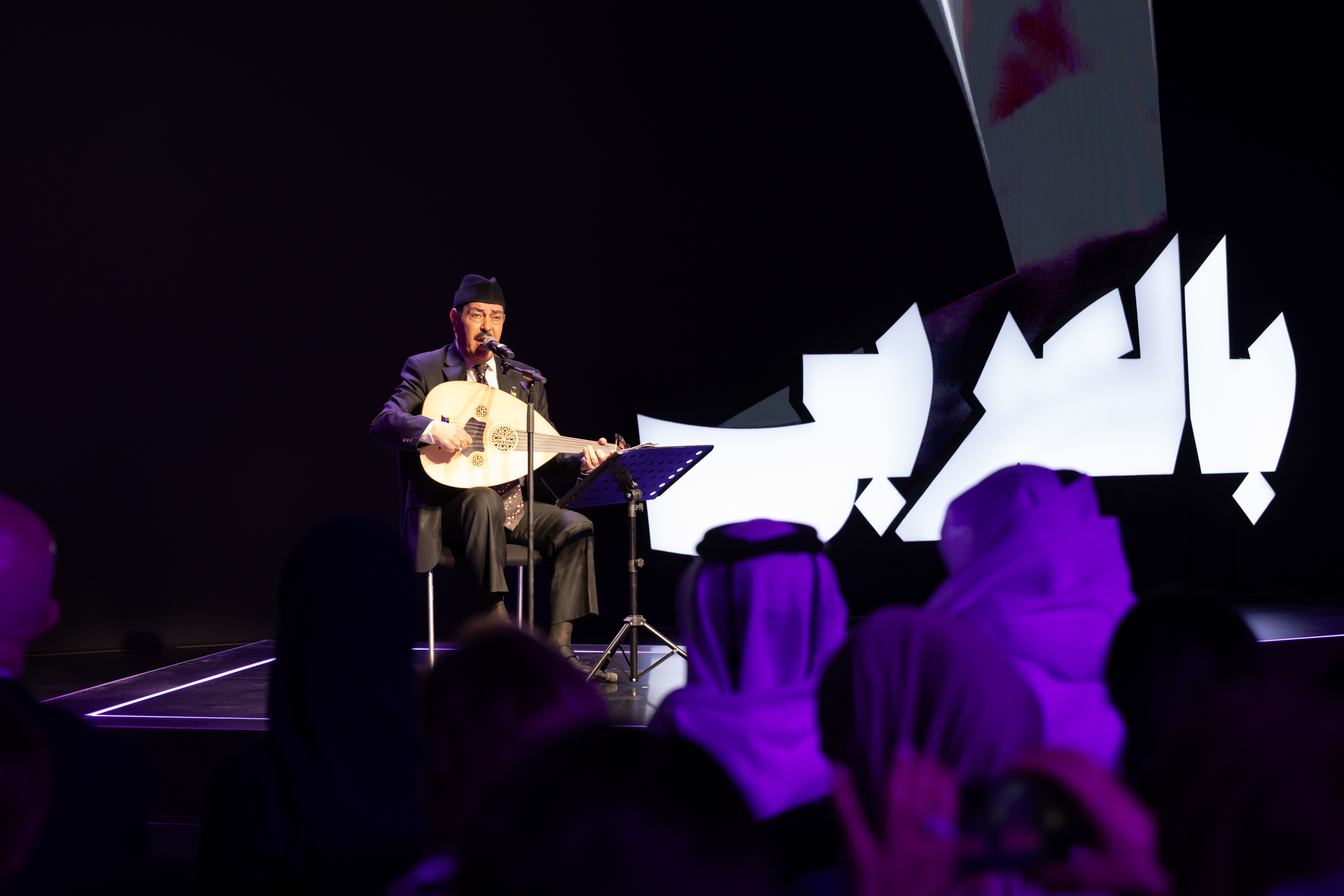
The summit opened with a powerful performance by renowned Tunisian artist Lotfi Bouchnak. As the tones of the oud echoed through the hall, Bouchnak’s voice stirred memory, evoked emotion, and answered the call of identity. “I am the Arab, the last to remain — bearing witness to life, through life,” he said.
His performance wasn’t just artistic — it was a message of unity and cultural continuity. In his presence, every note touched the intellect and stirred the spirit.
He was the first of many. Across two days, Arab creators from diverse fields gathered on a shared stage where music, storytelling, and heritage converged — reshaping the relationship between individuals and their language, identity, and history.
Stories: The Memory of the People
In a session titled Identity is Untranslatable, Yemeni engineer and blogger Fidaa Aldeen Yahya led the audience on a powerful narrative journey.
“Stories are the memory of the people. If we don’t write them, others will — with voices that don’t sound like ours. When a civilization is stripped of its language and culture, its language loses meaning, impact, and power,” he said.
His storytelling highlighted neglected chapters of Arab and human history, igniting reflection and a renewed sense of identity. The audience smiled, reflected, and left asking themselves: Who are we? And what still remains of us?
Melody: When Music Speaks Arabic
Renowned Egyptian composer Dr. Mustafa Saeed invited the audience on an exploration journey in a session titled Melody: An Identity. The session revealed the deep bond between Arabic melodies, language rules, and rhythms — delivering a beautiful musical experience.
“Our heritage isn’t a museum exhibit — it’s a foundation on which we build a distinctive literary and artistic future. One where melodies are born from originality, not from replication or imitation,” he said.
He emphasized that progress begins by reading our history as a guide to the future. “Arabic music can only thrive when studied in our language, felt through our emotions, and inspired by our traditions. Classical Arabic music is not a relic — it’s a cultural necessity.”
Art as a Bridge Between Cultures
In the session Occupations as Identity, academic Shawq Al-Alawi, a specialist in arts and cultural studies, delivered a heartfelt talk on women’s traditional crafts in the Gulf as both a visual identity and a social voice equal in power to poetry and song.
Holding a Master’s in Sociology and Arts from Griffith University, Al-Alawi showcased the role of Gulf women in preserving heritage and reimagining it for future generations.
“Art doesn’t belong on walls alone — it’s a catalyst for change, a spark for dialogue, and a mirror that shows us what we sometimes fear to see,” she explained.
Al-Alawi emphasized the importance of documenting stories as a way of safeguarding living heritage and identity. “Modernity isn’t built from nothing — it is woven from threads, shaped by pottery patterns, and held together by the hands of mothers.”
O History, Speak
In the evocative session titled The Legacy of the Granddaughter of the Queen of Sheba, Yemeni archaeologist Dr. Amida Sholan recounted her journey through the ruins of Ma’rib and museum collections around the world. To her, scattered Yemeni artifacts were not just museum pieces — they were living witnesses to a thriving civilization.
“I bring you news from Yemen — with certainty,” she said, before sharing her journey. “I wasn’t passionate about history in school, but fate made me a witness to languages once spoken by our ancestors, now preserved in stone and inscription.”
Sholan concluded with a heartfelt appeal: “We want our children to touch history — not just read it. To feel their roots reaching deep into the earth. What our ancestors left us was not for exhibition — it was for life, pride, and legacy. And when time returns, the artifacts that left us will return too — to tell our story once more, in their original tongue.”
BilAraby — A Cultural Movement, Not Just a Summit
The BilAraby Summit was more than a seasonal event — it marked the beginning of a permanent cultural movement launched by Qatar Foundation to reclaim Arabic as a language of original creativity, not just translation, and as a platform for ideas, not slogans.
This summit is just one milestone in a broader initiative that brings together thinkers, artists, and innovators — all speaking one language that requires no interpreter: the language of identity.